ChatGPT Ads, AI, Digital Marketing
ChatGPT Ads in New Zealand: Everything We Know Today
Find out the latest updates on how to run ads on ChatGPT.
Find out the latest updates on how to run ads on ChatGPT.
ChatGPT Ads, AI, Digital Marketing · 12 July 2026
ChatGPT ads have been live in New Zealand since April 2026. Any NZ business can now run ChatGPT ads, entry costs have dropped from a $50,000 commitment to $25 USD per day, and conversions can finally be tracked. Here's everything we know three months in.
For most of us, "Google it" and "search it" are the same sentence. Google has, for many years, dominated how the world searches. But that's changing fast - AI is the new player in the game. People are increasingly turning to AI to research, compare and make important decisions.
When ChatGPT ads were first released, TooGood posted an article on the first glances of ChatGPT ads in Aotearoa, with Macpac getting in early and being one of the first NZ businesses to serve ChatGPT users with their ads. A lot has changed since then, so it's worth getting a clear read on how the ads work now and whether they're right for your business.
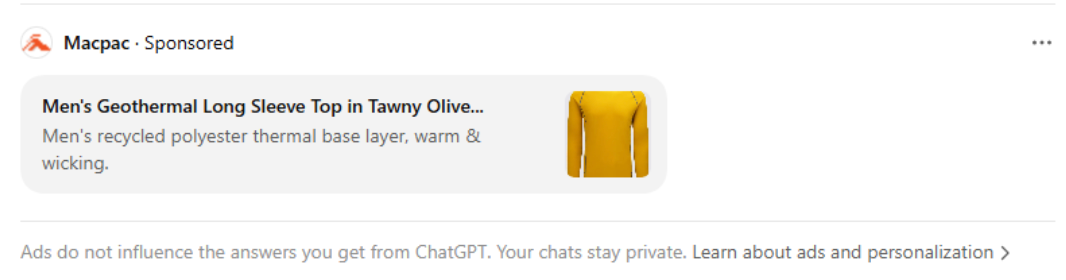
This is an example of an ad for a trusted Kiwi brand, Macpac. The ads are easy to spot - like Google Ads, they carry a "Sponsored" label. Sitting on a shaded background, they stand out clearly and transparently from the answer rather than trying to pass as part of it.
Only Free and Go users see ads. Plus, Pro, Business, Enterprise and Edu, i.e. the higher tiered plans won't see them. This is interesting to think of in terms of customers - if your clientele is made up of AI "power users", then you may not be able to reach as many people as you originally had planned.
Targeting is still country-level only for now. There are no city or postcode definitions, so businesses will be targeting the whole of New Zealand. Bear in mind, this will not work for businesses only operating in certain cities.
The audience is worth putting in perspective. As of February 2026, OpenAI reports ChatGPT has more than 900 million weekly active users worldwide, and even with ads limited to Free and Go accounts, that is a very large pool of people asking questions and making decisions every day.
One more rule on who sees them: ads will not be served to anyone under 18, or to accounts OpenAI predicts are under 18.
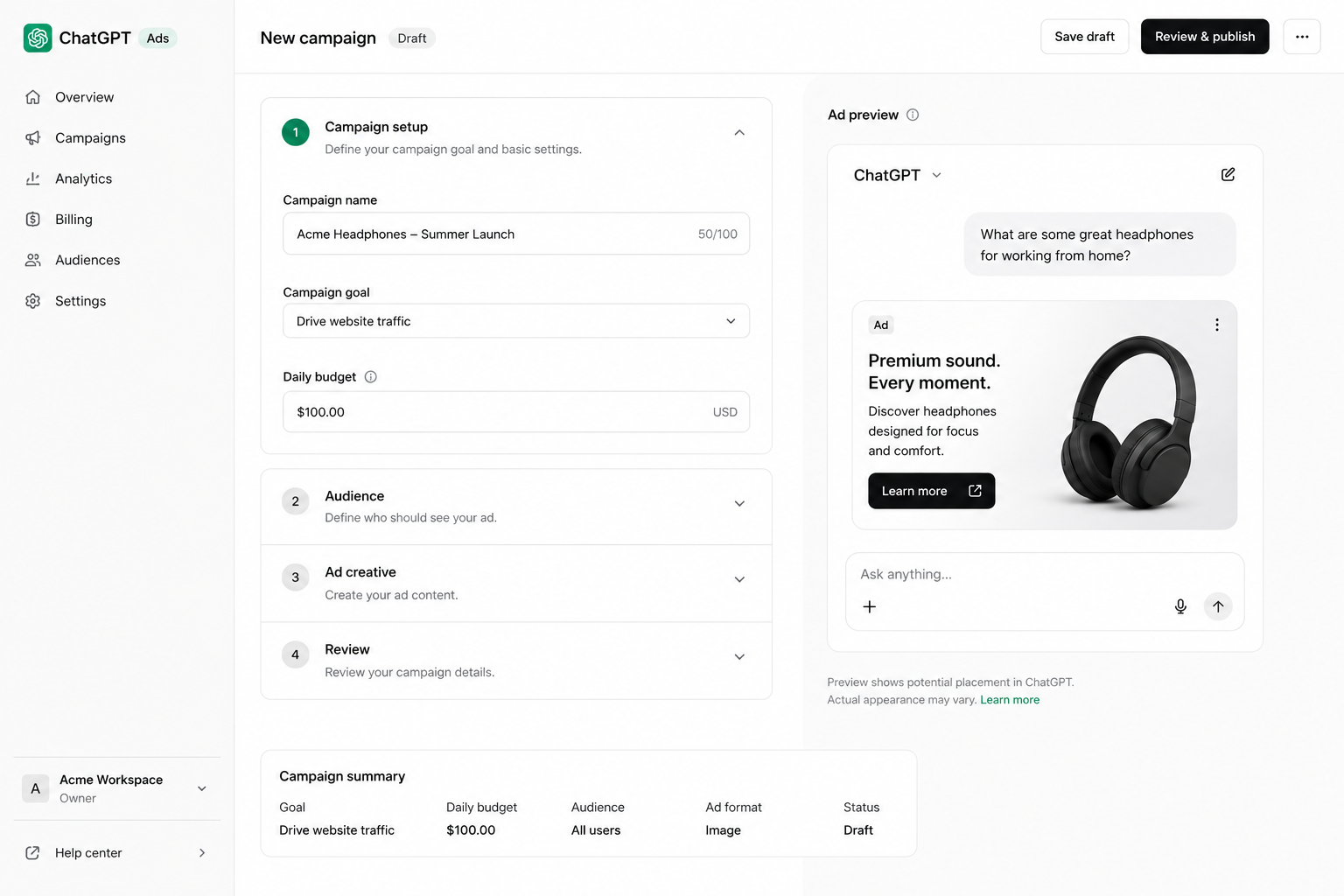
Instead of headlines, descriptions & keywords, marketers input 'context hints' to create the ad copy. After spending years working on Search, Display and Performance Max campaigns, this concept will feel very new to your marketing agency.
Context hints aren't exactly a search term or keywords. They're essentially describing a situation that the potential buyer is in. The context hint is matched against the live conversation of ChatGPT users and the platform will decide whether the live conversation and the hint is close enough to serve.
Here are some examples of context hints for different types of businesses.
For a storage or moving company:
Coffee roaster:
Bed retailer:
Accountant:
OpenAI itself will decide which advertiser's queries are most relevant - there's no keyword auction.
There are heavy restrictions on a few industries. Health, mental health and politics are excluded. If you're running a dental practice, a psychologist or a political party, you will not be able to run ads on OpenAI. It's also important to note that no ads will serve under-18s as well.
Originally, ads were limited to larger businesses or smaller and medium sized businesses with money to spare - pilot testing was as much as $250K USD, then in April this was lowered to a $50k commitment, and now the floor is $25/day per campaign.
Clicks aren't cheap - as of July 2026, OpenAI's recommended starting bid is around $3 - $5 USD per click ($5 - $9 NZD). If you pay per view instead, the CPM is roughly $25 - $60 USD.
Tracking is currently limited, and this is probably the biggest limitation to OpenAI ads. If set up incorrectly like in Google Tag Manager, you'll get incorrect numbers.
Yes, you can track conversions. You'll be able to see a sale or enquiry attributed towards a ChatGPT ad. However, you cannot optimise towards conversions. This is not yet available in OpenAI - the two objectives currently are clicks (CPC) or views/reach (CPM), not "conversions." Watch this space, this is bound to be available in the future.
To set up tracking, you'll want two tools running together. The first is the OAIQ pixel. This is a tracking code created for you by OpenAI. It goes in the <head> of your site (not the body, or it'll miss visits). It records OpenAI's click ID so a sale can be traced back to the ad that was served.
The second is the Conversions API which feeds numbers back into Ads Manager's reporting. If you're running both, give each conversion one shared ID to ensure it isn't double counted.
Top tip: Add UTM tags to your landing page links so you can see ChatGPT traffic alongside your other channels in Google Analytics. If you have a "how did you hear about us?" question on your contact form, be sure to add ChatGPT. It's possible that a customer will have seen your ads on AI first, and later converted through Google Search. By adding ChatGPT as an option on your contact form will give ChatGPT the credit for the sale and ensure your data is accurate and true.
Getting the pixel, the Conversions API and the deduplication right is fiddly, and it's the part we see set up wrong most often. It's also the first thing we fix when we take over a ChatGPT ads account.
Advertising on AI platforms is still very new, and as of mid 2026, platform-wide click-through is still under 1%. This is not surprising. Facebook ads didn't actually perform well in the very early days, while the model learns. Getting in early means reaching Kiwi customers before your competitors do - and learning how the channel works while it's still affordable and uncrowded.
One more thing worth knowing: ads are only one way to show up in ChatGPT. Your business can also appear organically in the answers themselves, which is a separate discipline entirely. We've covered how to rank on ChatGPT in its own guide.
If you already run Google Ads, here's how the two channels line up right now:
ChatGPT Ads
Google Ads
Targeting
Context hints describing a buyer's situation
Keywords, audiences, demographics, remarketing
Geo targeting
Country level only (all of NZ)
Country down to city and radius
Bidding
CPC or CPM, no auction on keywords
Keyword auction with smart bidding options
Conversion tracking
Yes, via OAIQ pixel and Conversions API
Yes, mature and well documented
Optimise towards conversions
Not yet
Yes
Minimum spend
$25 USD per day per campaign (as of July 2026)
None
Maturity
Beta, formats and features still changing
25+ years, stable
The short version: Google Ads is still the workhorse. ChatGPT ads reach people earlier, while they're still thinking a decision through, but with blunter targeting and younger measurement. Treat them as complementary channels, not a swap.
Because we've been watching this channel from day one, we can show you exactly how quickly it's moving. In April, the picture looked like this:
Three months later:
OpenAI has also said more than 600 advertisers are already on the platform. The pattern is clear. Each month the channel gets cheaper to enter, easier to measure and more crowded. The businesses that benefit most from a new ad platform are usually the ones who learn it before their competitors arrive.
Since June 2026, product catalogues can be connected directly to OpenAI's ad manager. This time saver builds the ads for you from product names, images and other details, working in a similar respect to Google Shopping.
After uploading your catalogue to the server, the ads manager will let you know which products are ad-eligible. Note that you must have over 1,000 products to use product feeds in ChatGPT ads. The system will learn over time what your strongest products are, rather than pushing all of your products as ads.
Our experience implementing feeds in ChatGPT Ads:
If you're using or starting to use ads on AI platforms in the early stages, here's what we'd recommend:
TooGood now runs ChatGPT ads for NZ businesses alongside Google and Meta. If you want to know whether the channel fits your business, or you'd rather someone who's already inside the ads manager set it up properly, take a look at our ChatGPT ads management service or get in touch.